




The history of pharmacy technicians connects an ancient need—preparing and documenting medicines—with a modern healthcare career built around accuracy, technology, and patient safety. But there is an important distinction: pharmacy technicians did not practice as today’s regulated professionals in 1500 BC. That date points to early pharmaceutical records, while the modern technician role developed much later.
For someone considering this career, the history offers more than interesting facts. It explains why pharmacy technicians now need structured knowledge, practical skills, and a clear understanding of their responsibilities.
This guide follows the journey from ancient remedies to modern pharmacy teams, then explains what that evolution means for pharmacy technician training and careers in California.
Pharmacy Technician History Timeline: Ancient Records to Modern Careers
Pharmacy history and pharmacy technician history overlap, but they are not interchangeable. Early milestones describe the development of medicines and pharmacy practice. Later milestones document the emergence of technician education, credentials, and specialized responsibilities.
| Period | Milestone | Connection to the modern career |
|---|---|---|
| Around 1550 BC | The Ebers Papyrus records ancient Egyptian medical knowledge and remedies | An early example of documenting treatments |
| Before modern professional training | Medicine preparation develops through varied traditions and apprenticeship practices | Practical learning precedes standardized education |
| 1906 | The U.S. Food and Drugs Act addresses adulterated and misbranded products | Medication quality and labeling receive stronger federal oversight |
| 1938 | Federal law requires evidence of new-drug safety before marketing | Drug regulation becomes more demanding |
| 1960s–1970s | Technician roles become more formal as pharmacy practice evolves | Support work develops into more defined responsibilities |
| 1982–1983 | ASHP adopts accreditation standards and accredits its first technician training program | Structured technician education gains a national framework |
| 1995 | The Pharmacy Technician Certification Board is established | National technician certification gains a unified standard |
| 2014 | The Pharmacy Technician Accreditation Commission is formed | ASHP and ACPE collaborate on program accreditation |
| Today | Technology and specialized practice create additional technician responsibilities | Continuing education and practical competence remain important |
The ancient date is supported by Leipzig University Library’s description of the Ebers Papyrus. Modern education milestones are documented by TPTS, while FDA records explain the regulatory developments.
Pharmacy History Around 1500 BC: What the Ebers Papyrus Really Shows
Long before electronic prescriptions, people recorded information about illnesses and remedies by hand.
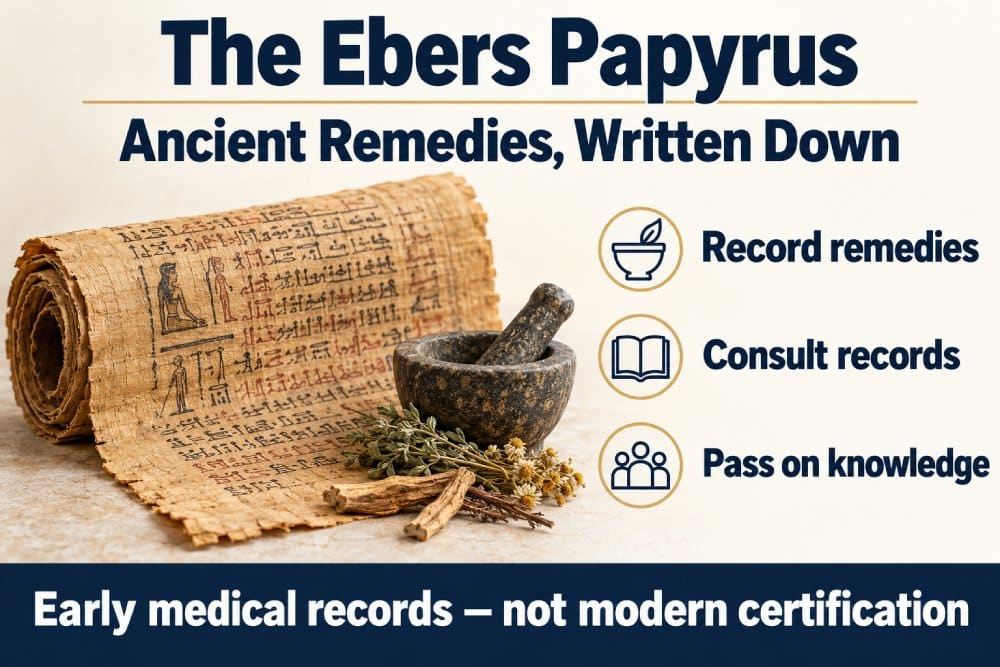
The Ebers Papyrus, preserved by Leipzig University Library, is an ancient Egyptian medical manuscript dating to the late 16th century BC. It provides an important window into the medical knowledge of its time.
Its relevance to pharmacy is documentation: information about remedies could be recorded, consulted, and passed on.
However, calling the people involved “certified pharmacy technicians” would project a modern profession onto a very different society. They did not work within today’s systems of state licensure, national certification, or evidence-based medication regulation.
For a prospective student, the useful connection is straightforward: recording information carefully has a long history, but modern pharmacy requires far more than preserving a recipe. It requires reliable procedures, defined responsibilities, and current scientific knowledge.
From Apprenticeships to Modern Pharmacy Practice
For much of history, practical knowledge about preparing medicines was learned through direct experience. The organization of that work varied across places and periods.
As pharmacy developed, education, drug manufacturing, and regulation changed the skills that pharmacy teams needed. In the United States, the 1906 Food and Drugs Act prohibited interstate commerce in adulterated and misbranded drugs. The 1938 Federal Food, Drug, and Cosmetic Act subsequently required new drugs to be tested for safety before marketing.
These laws did not create the pharmacy technician profession. They help explain the increasingly regulated environment in which that profession would develop.
That context still matters. A pharmacy is a workplace where labeling, records, storage, and handling procedures support a larger medication safety system.
When Did Pharmacy Technicians Become a Modern Profession?
There is no single ancient starting date for the modern occupation.
A 2026 commentary in the American Journal of Health-System Pharmacy describes technician roles emerging in the 1960s and 1970s as pharmacists expanded their clinical responsibilities. Training was often informal and employer-based before more structured education developed. Several later milestones helped define the profession.
Pharmacy technician education became more standardized
ASHP approved technician education and training accreditation standards in 1982. In 1983, it accredited the first hospital-based technician training program at Thomas Jefferson University Hospital.
The significance for students is the shift toward an organized body of knowledge and demonstrable skills. Learning to perform a task is important; understanding the procedure, its limits, and its safety purpose is equally important.
National pharmacy technician certification developed
PTCB was established in 1995 through collaboration among pharmacy organizations. Its creation became a major milestone in national technician credentialing.
Today, PTCB certification is a separate credential from a school diploma and a state license. Understanding that distinction can help students compare programs more effectively.

What Does a Pharmacy Technician Do Today?
Pharmacy technicians support pharmacists in preparing and dispensing prescription medications. Common work includes prescription processing, medication packaging and labeling, inventory support, and administrative tasks. Responsibilities depend on the setting, applicable law, and training.
Technicians work in community pharmacies, hospitals, and other healthcare environments. Some positions involve evening or weekend schedules.
The practical demands go beyond recognizing medication names.
Consider a fictional training scenario: a prescription arrives, but a required piece of information is missing. A prepared technician follows the pharmacy’s procedure, identifies the issue, and brings it to the appropriate person. The technician does not fill in the gap by making an independent clinical decision.
That is an important career skill: knowing when to continue a process and when to stop and ask.

Want to Learn Pharmacy Technician?
Develop professional Pharmacy Technician skills through career-focused training at ACHT.
Explore Pharmacy Technician Program →How Technology Is Changing Pharmacy Technician Careers
Automation is another chapter in the profession’s history.
Modern pharmacy systems can support dispensing workflows, inventory processes, and information management. The practical question for a future technician is how to work accurately within those systems—and how to recognize when something needs attention.
For example, a system alert is useful only when the person handling the workflow understands the required response. Familiarity with technology should support careful work, rather than encourage automatic acceptance of every screen or prompt.
When comparing programs, ask how students practice computer-based workflows and learn to escalate problems.
California also illustrates how responsibilities can change through legislation. The Board’s current guidance describes expanded duties for qualifying certified technicians, including certain vaccine-related tasks, under specified supervision, training, and staffing conditions. These are conditional responsibilities, rather than universal entry-level duties.
Explore Pharmacy Technician Training at ACHT
The profession has evolved from informal support work toward more structured education and defined responsibilities. Your next step is to understand what preparation would look like in practice.
American College of Healthcare and Technology’s current program page lists a nine-month Pharmacy Technician Diploma program, hybrid learning with in-person hands-on training, and locations in Riverside and Huntington Park.
Want to Learn Pharmacy Technician?
Develop professional Pharmacy Technician skills through career-focused training at ACHT.
Explore Pharmacy Technician Program →The published curriculum includes prescription processing, pharmacy calculations, medication labeling, pharmacy law and ethics, and operations-related skills. New classes are listed as starting monthly.
Before deciding, ask admissions how the current schedule, training requirements, and costs fit your circumstances.
Get a clearer picture of your next step.
Request Pharmacy Technician Program Information to review the program and connect with admissions, or call (888) 430-4224.
Ask about upcoming starts, campus availability, tuition, practical training, and preparation for applicable credentialing requirements. Enrollment, graduation, certification, licensing, and employment each involve their own requirements.