


Are you detail-oriented, organized, or someone who enjoys solving problems? Your personality could be a good match for a career in medical billing and coding.
Not every healthcare career involves direct patient care. Some professionals make an important contribution behind the scenes by organizing medical information, reviewing documentation, and helping healthcare providers process insurance claims.
Medical billing and coding is one of those career paths. But is medical billing and coding right for you?
Four personality types may be particularly well suited to this field: the detail-oriented organizer, the analytical problem-solver, the independent and focused worker, and the trustworthy communicator.
You don’t need to fit every description to explore this career. More importantly, many of the skills that medical billers and coders use can be developed through education, training, and practice.
In this guide, you’ll discover which personality traits can support success in medical billing and coding, what the work actually involves, and how to take your first steps toward the profession.

Want to Learn Medical Billing & Coding?
Develop professional medical billing & coding through career-focused training at ACHT.
Explore Medical Billing & Coding Program →What Personality Is Best for Medical Billing and Coding?
The best personality for medical billing and coding generally combines attention to detail, analytical thinking, organizational ability, integrity, and communication skills.
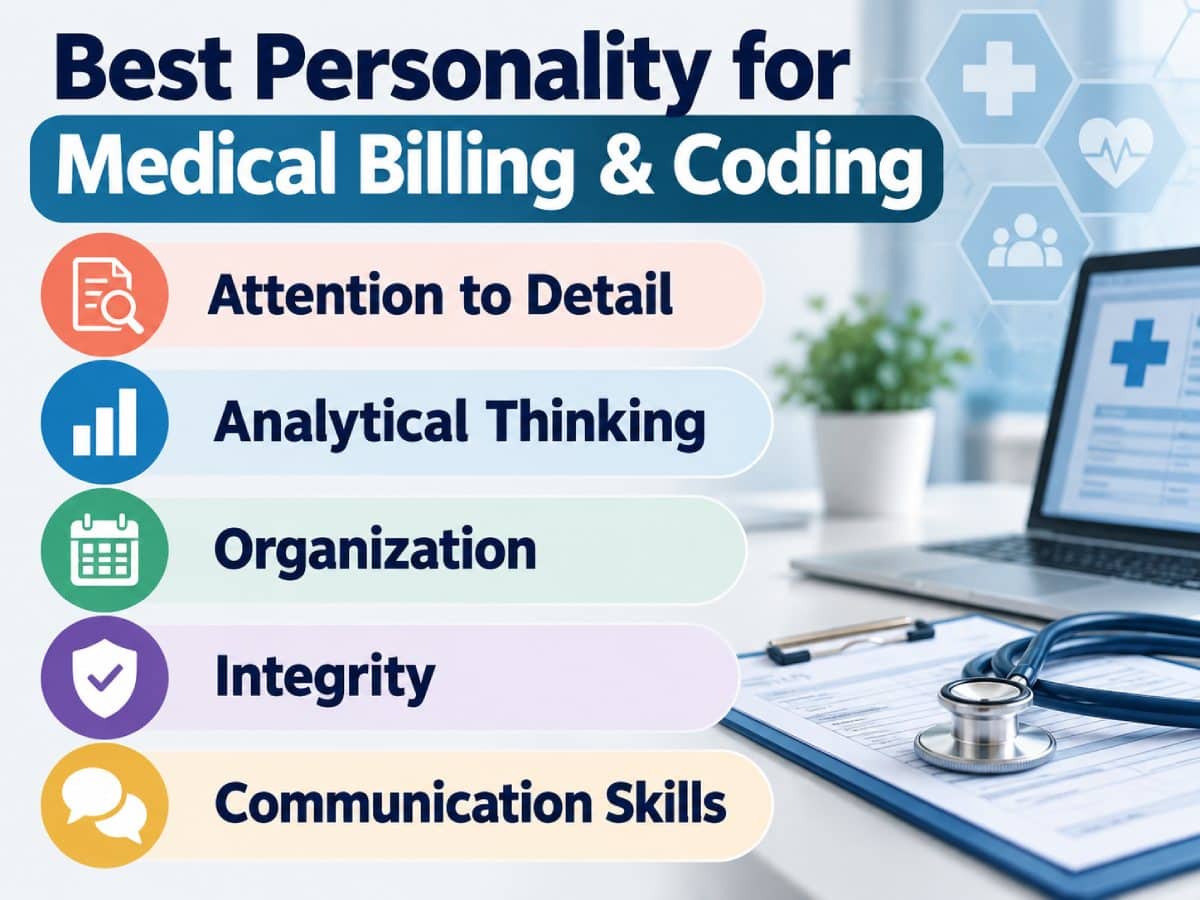
According to the U.S. Bureau of Labor Statistics (BLS), important qualities for medical records specialists include analytical skills, attention to detail, integrity, and interpersonal skills.
These qualities help professionals interpret medical documentation, identify discrepancies, protect sensitive patient information, and communicate with other healthcare workers. However, there is no single perfect medical billing and coding personality type.
Different strengths can support different responsibilities.
| Personality type | Key strength | How it helps at work |
|---|---|---|
| The Detail-Oriented Organizer | Accuracy and organization | Reviewing records and preventing errors |
| The Analytical Problem-Solver | Investigation and logical thinking | Identifying coding discrepancies and researching claim issues |
| The Independent and Focused Worker | Concentration and self-discipline | Managing documentation and computer-based tasks |
| The Trustworthy Communicator | Integrity and collaboration | Protecting patient information and resolving questions |
The key takeaway: You do not have to be naturally outgoing, exceptionally good at math, or experienced in healthcare to begin exploring medical billing and coding. What matters is your willingness to develop the technical knowledge and professional habits the job requires.
1. The Detail-Oriented Organizer: You Notice the Small Things
Attention to detail is one of the most important personality traits for medical billing and coding. Professionals in this field review medical records, assign codes, and process billing information where even small mistakes can lead to claim delays or errors.
Signs you’re a detail-oriented person:
- You notice small mistakes or missing information.
- You enjoy keeping records and tasks organized.
- You double-check your work for accuracy.
- You prefer clear instructions and structured processes.
These qualities can help you work accurately with medical terminology, ICD-10-CM, CPT, and other healthcare coding systems.
2. The Analytical Problem-Solver: You Enjoy Finding Answers
Medical billing and coding requires more than entering information into a computer. Professionals often investigate coding discrepancies, review rejected insurance claims, and determine how to resolve documentation issues.
If you enjoy researching, solving puzzles, or understanding why something went wrong, your analytical thinking skills could make medical billing and coding a rewarding career choice. These skills are particularly useful when reviewing medical documentation, applying coding guidelines, and resolving insurance billing issues.
3. The Independent and Focused Worker: You Enjoy Concentrated Work
Is medical billing and coding good for introverts? Yes, it can be an excellent option for people who prefer focused, computer-based work rather than constant face-to-face patient interaction.
Medical billers and coders often spend time reviewing records, using healthcare software, and processing information independently. However, communication with healthcare teams and insurance providers may still be required. Signs you’re an independent and focused worker:
- You enjoy working quietly and independently.
- You can concentrate on detailed tasks.
- You are comfortable using computers.
- You manage your time and responsibilities well.
Some medical billing and coding positions also offer remote or hybrid work arrangements, although availability and employer requirements vary.
4. The Trustworthy Communicator: You Value Responsibility and Privacy
Medical billing and coding professionals handle sensitive patient information, making confidentiality, honesty, and professional communication essential. They must follow privacy requirements, including applicable HIPAA regulations, while maintaining accurate records.
If you’re responsible, trustworthy, and comfortable communicating with others when necessary, you may have valuable qualities for this healthcare career. These traits help medical billers and coders protect patient information, collaborate with healthcare professionals, and maintain ethical billing and coding practices.
Ready to start your healthcare career?
Get program details, admission requirements, and personalized guidance from our team.
Request Program Information →Medical Billing vs. Medical Coding: Which Role Fits Your Strengths?
Although the terms are often used together, medical billing and medical coding involve different responsibilities. Understanding that distinction can help you choose the work that best matches your interests.
| Medical Coding | Medical Billing |
|---|---|
| Reviews clinical documentation | Processes insurance claims and billing information |
| Assigns appropriate medical codes | Tracks claim status and payments |
| Uses coding guidelines and classification systems | Works with insurance requirements and billing procedures |
| Emphasizes documentation analysis and precision | Emphasizes organization, follow-up, and problem-solving |
| May require clarification from clinical staff | May communicate with payers, patients, or healthcare offices |
If you love research, rules, and precise documentation, you may find medical coding particularly appealing.
If you enjoy organizing workflows, resolving issues, and communicating, medical billing responsibilities may interest you.
Some positions combine both functions, especially in smaller healthcare organizations. Learning about both areas can help you understand how information moves through the healthcare revenue cycle.
Ready to Explore Medical Billing and Coding Training in Southern California?
If you recognized some of your strengths in the four personality types, medical billing and coding could be a career worth investigating further.
Want to Learn Medical Billing & Coding?
Develop professional medical billing & coding through career-focused training at ACHT.
Explore Medical Billing & Coding Program →At American College of Healthcare and Technology (ACHT), students can explore career-focused medical billing and coding education through a diploma program offered at three Southern California campuses:
- Riverside
- Santa Ana
- Huntington Park
The Medical Billing & Coding program is designed to help students build foundational knowledge and practical skills for healthcare billing and coding environments.
You can speak with an admissions representative to learn about the curriculum, current class availability, tuition, and financial aid options for eligible students. You do not have to decide on your entire career today. Learning what the program includes is a useful first step toward making an informed decision.