




Want to work in healthcare without spending four years earning a college degree? You have more options than you might think.
Some healthcare jobs that pay well require a certificate or diploma rather than a bachelor’s degree. Others offer higher salaries but take approximately two years of specialized education, clinical training, or professional licensing.
This guide compares 13 healthcare careers using the latest available U.S. Bureau of Labor Statistics (BLS) national median wage data for May 2025, along with education requirements and practical considerations for people planning to work in California.
Quick answer: Medical assisting, dental assisting, pharmacy technology, medical billing and coding, and surgical technology are among the career paths worth exploring if you want to avoid a traditional four-year degree. Higher-paying options such as diagnostic medical sonography and radiologic technology generally require more extensive education and professional credentials.
High-Paying Medical Jobs With Little Schooling: Salary Comparison
Before choosing a healthcare career, compare both the salary and the education needed to qualify.
The table below includes careers that typically require less than a bachelor’s degree. However, less schooling does not mean every career requires only a few months of training.
| Healthcare Career | U.S. Median Annual Pay (2025) | Typical Education or Training |
|---|---|---|
| Dental Hygienist | $98,100 | Associate degree; programs commonly take about 3 years |
| Diagnostic Medical Sonographer | $96,590 | Usually associate degree; some certificate pathways |
| Radiologic Technologist | $80,110 | Typically associate degree |
| Occupational Therapy Assistant | $72,300 | Accredited associate degree and state licensure |
| Physical Therapist Assistant | $68,380 | Accredited associate degree and state licensure |
| Surgical Technologist | $64,650 | Postsecondary certificate or associate degree |
| Licensed Vocational Nurse (LVN) | $64,400 | State-approved nursing program and license |
| Massage Therapist | $58,450 | Postsecondary training; requirements vary |
| Medical Records Specialist | $51,140 | Usually a certificate or other postsecondary training |
| Dental Assistant | $48,070 | Training requirements vary by state and duties |
| Pharmacy Technician | $45,750 | Postsecondary training or qualifying on-the-job pathway |
| Medical Assistant | $45,690 | Usually a certificate or other postsecondary training |
| Phlebotomist | $45,230 | Postsecondary training; certification rules vary |
Source: U.S. Bureau of Labor Statistics, Occupational Outlook Handbook, May 2025 national median annual wages. These are national medians, not starting salaries or California-specific wages. Education requirements vary by occupation and state.
What this comparison tells you: The careers with the highest median salaries are not necessarily the fastest to enter. If your goal is to begin working sooner, a shorter career-training program may be more realistic than spending several years preparing for a more specialized profession.
Best Healthcare Jobs That Pay Well With Less Than One Year of Schooling
If finishing school quickly is a major priority, several healthcare careers offer relatively accessible entry routes.
The following occupations may have training pathways that can be completed in approximately nine months or less, depending on the institution, program, and state requirements.
1. Medical Assistant — A Practical Entry Into Healthcare
Median annual salary: $45,690
Typical education: Postsecondary certificate or similar training; some employers provide qualifying on-the-job training.
Medical assistants perform administrative and clinical support tasks in healthcare settings. Depending on their training, work environment, and state laws, their responsibilities may include taking vital signs, preparing examination rooms, updating medical records, scheduling appointments, and assisting with authorized procedures.
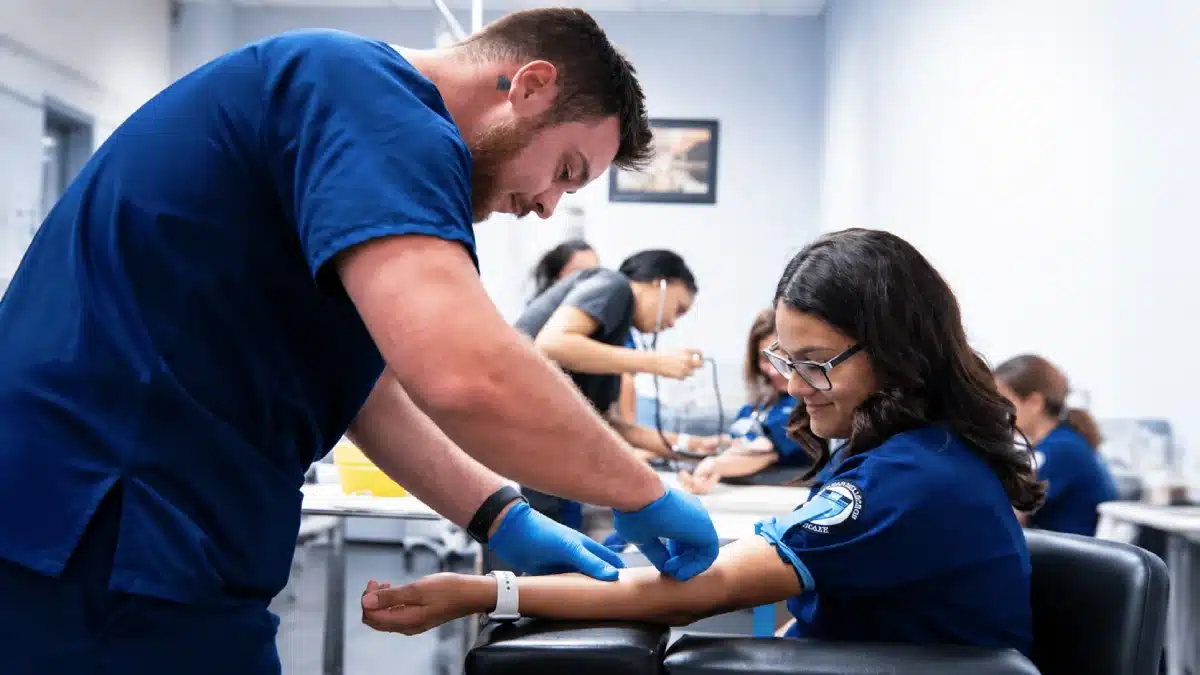
Why consider medical assisting?
- You can develop both administrative and clinical skills.
- Training programs may be substantially shorter than degree-based healthcare pathways.
- Experience can provide a foundation for further healthcare education.
- The BLS projects 13% employment growth from 2025 to 2035.
What to consider: Medical assisting is not one of the highest-paying medical professions overall. However, its relatively accessible training requirements and broad clinical responsibilities can make it an attractive starting point.
For students interested in a structured training route, ACHT offers a Medical Assistant training program designed to develop the clinical and administrative skills used in healthcare workplaces.
2. Dental Assistant — Work Directly With Dental Teams
Median annual salary: $48,070
Typical education: Varies by state; formal programs can provide preparation for entry-level employment.
Dental assistants help keep dental practices running efficiently. Their work may include preparing treatment areas, organizing instruments, assisting dentists during procedures, and supporting patient education.

Why consider dental assisting?
- Opportunities to work in general or specialty dental practices.
- A combination of clinical and organizational responsibilities.
- Potential to pursue additional credentials and legally authorized duties.
What to consider: A dental assistant is not the same as a dental hygienist. Hygienists generally need more education and must meet separate licensing requirements.
If dental healthcare interests you, explore the Dental Assistant program at ACHT and ask which credentials and duties the program prepares graduates to pursue.
3. Pharmacy Technician — A Healthcare Career Focused on Medication Safety
Median annual salary: $45,750
Typical education: High school diploma plus qualifying training or a postsecondary program; state registration or licensing requirements apply.
Pharmacy technicians support pharmacists by processing prescriptions, maintaining inventory, assisting with medication distribution, and handling pharmacy-related records.

Why consider pharmacy technology?
- You work with medication-related processes and healthcare information.
- Jobs exist in different pharmacy settings.
- The work combines accuracy, technical skills, and communication.
What to consider: You must be comfortable following detailed procedures, handling sensitive information, and working under professional supervision. California pharmacy technician registration requirements must be satisfied before practicing in regulated roles. ACHT offers a Pharmacy Technician training program that includes pharmacy operations and medication-safety fundamentals.
4. Medical Billing and Coding — Healthcare Without Constant Patient Contact
Related occupation median annual salary: $51,140 for medical records specialists
Typical education: Postsecondary certificate or similar training; employer requirements vary.
Medical billing and coding professionals help organize healthcare information, translate documentation into appropriate codes, and support insurance and reimbursement processes. This path may appeal to people who enjoy computers, documentation, organization, and detailed work.

Why consider medical billing and coding?
- Many positions focus on information rather than direct clinical care.
- You develop knowledge of medical terminology and healthcare documentation.
- Certain roles may eventually provide remote or hybrid work opportunities, depending on employer policies and experience.
What to consider: Remote employment is not guaranteed, especially for beginners. Some employers prefer candidates with coding credentials or practical experience.
If you prefer the administrative side of healthcare, ACHT’s Medical Billing and Coding program offers a nine-month training pathway covering medical terminology and billing-related workflows.
5. Phlebotomist — Specialized Patient Care With Focused Training
Median annual salary: $45,230
Typical education: Postsecondary training and, depending on the state, certification.
Phlebotomists collect blood samples for laboratory testing, transfusions, donations, and other approved purposes. Their work requires patient communication, careful identification procedures, infection-control knowledge, and technical precision.
Why consider phlebotomy?
- A focused clinical role rather than a broad four-year degree.
- Direct interaction with patients.
- Employment possibilities in laboratories, healthcare facilities, and blood collection services.
What to consider: People who dislike needles or repeated blood collection tasks may prefer another occupation.
In California, phlebotomy certification has specific training, clinical experience, and examination requirements overseen by the California Department of Public Health. A general medical assisting course does not automatically qualify someone for every phlebotomy position.
6. Physical Therapist Aide — Help Patients on Their Recovery Journey
Median annual salary: $35,240
Typical education: High school diploma or equivalent and on-the-job training; additional education may strengthen preparation.
Physical therapist aides help rehabilitation teams by organizing treatment spaces, preparing equipment, and performing administrative or supportive duties. This may be a good fit if you want to work around physical rehabilitation and recovery.
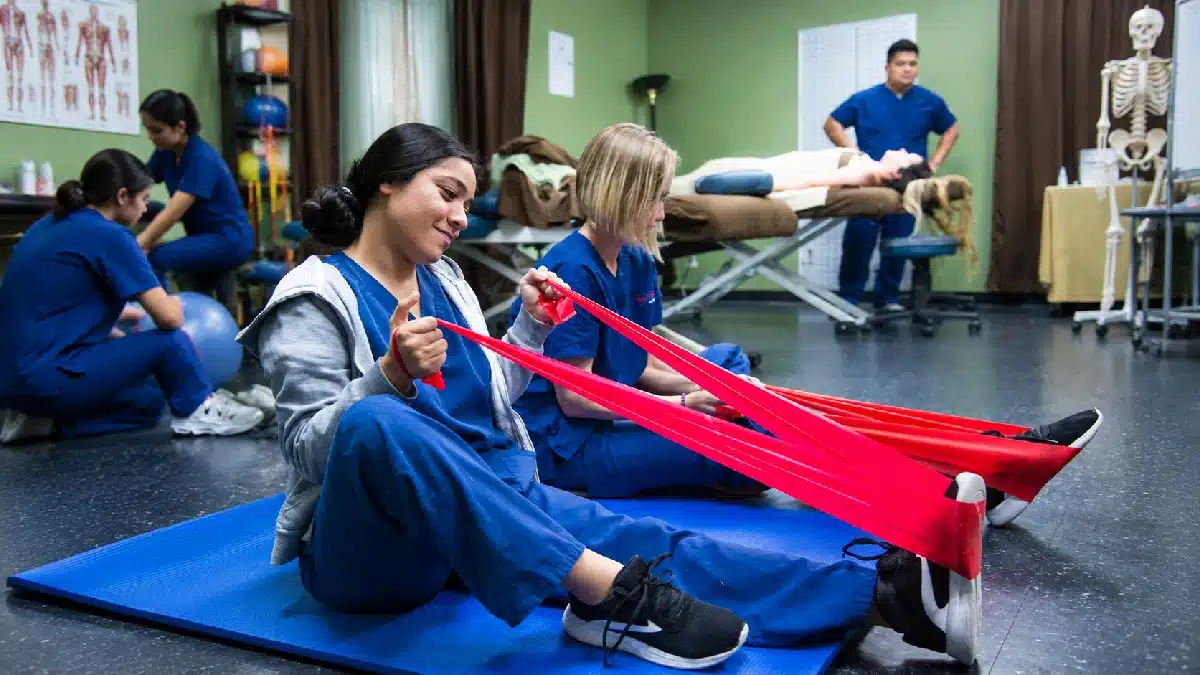
Why consider this role?
- Exposure to rehabilitation environments.
- Opportunities to develop interpersonal and organizational skills.
- An accessible starting point for exploring related healthcare careers.
What to consider: Physical therapist aides and licensed physical therapist assistants are different occupations. Assistants have more extensive education and licensing requirements and earn substantially more at the national median.
ACHT offers a Physical Therapy Aide training program for people interested in the rehabilitation side of healthcare.

Ready to start your healthcare career?
Get program details, admission requirements, and personalized guidance from our team.
Request Program Information →Best-Paying Medical Jobs With Little Schooling That May Require One to Three Years
If you are willing to spend more time in training, other healthcare careers may offer higher median salaries.
These are worth considering, but it is important to understand that they are not necessarily quick certificate-based careers.
7. Surgical Technologist — Build a Career in the Operating Room
Median annual salary: $64,650
Typical education: Postsecondary certificate or associate degree.
Surgical technologists prepare operating rooms, help maintain sterile environments, organize surgical instruments, and support surgical teams before, during, and after procedures.

Why consider surgical technology?
- A specialized role in the operating room.
- National median pay above several other entry-level healthcare support occupations.
- Opportunities in hospitals and outpatient surgery centers.
- Strong emphasis on technical knowledge and teamwork.
What to consider: Surgical environments can be physically demanding. Some positions require early starts, extended shifts, weekends, or on-call availability. Employers may require or prefer professional certification.
For students who want to pursue operating-room training, the Surgical Technology program at ACHT is an Associate of Occupational Science pathway listed at approximately 20 months at the Riverside campus.
8. Licensed Vocational Nurse (LVN) — Direct Nursing Care Without a Bachelor’s Degree
Median annual salary: $64,400
Typical education: State-approved practical or vocational nursing program followed by the required licensing examination.
Licensed vocational nurses provide nursing care under applicable supervision and state scope-of-practice rules.
Why consider vocational nursing?
- Direct involvement in nursing care.
- Potential to work in nursing facilities, medical offices, and other healthcare settings.
- A possible foundation for additional nursing education.
What to consider: LVN training and licensing are more demanding than many entry-level support programs. This pathway is not interchangeable with medical assisting.
9. Massage Therapist — A Hands-On Career Focused on Wellness
Median annual salary: $58,450
Typical education: Postsecondary training; state and local requirements vary.
Massage therapists use trained manual techniques to support client comfort, relaxation, and other appropriate wellness goals.
Why consider massage therapy?
- Hands-on work with clients.
- Potential flexibility in work settings.
- Opportunities to build a specialized practice with additional training and experience.
What to consider: Earnings can vary significantly because part-time employment and self-employment are common. The national median is not a prediction of take-home earnings or business profit.
10. Physical Therapist Assistant — A More Advanced Rehabilitation Role
Median annual salary: $68,380
Typical education: Accredited associate degree and applicable state licensure or certification.
Physical therapist assistants provide treatment-related support under the direction and supervision of licensed physical therapists. This occupation can be appealing to people who want a more direct role in rehabilitation.
Important distinction: A physical therapist assistant is not the same as a physical therapist aide. Completing an aide program alone does not qualify someone to work as a licensed physical therapist assistant.
11. Occupational Therapy Assistant — Support Everyday Independence
Median annual salary: $72,300
Typical education: Associate degree from an accredited occupational therapy assistant program and applicable state licensure.
Occupational therapy assistants help patients practice activities and techniques designed to support everyday functioning. They work under occupational therapists and may serve people recovering from illness, injuries, or other functional challenges.
12. Radiologic Technologist — Work With Diagnostic Imaging
Median annual salary: $80,110
Typical education: Associate degree and applicable licensing or certification.
Radiologic technologists produce diagnostic images that healthcare professionals use in evaluating medical conditions. The role combines patient care, technical equipment operation, radiation-safety practices, and careful positioning.
Why consider radiologic technology?
- Higher national median pay than many shorter certificate-based occupations.
- Technical work using medical imaging equipment.
- Opportunities for additional education and imaging specializations.
What to consider: You must complete the appropriate education and meet any applicable California licensing requirements. This is not typically a short nine-month training option.
13. Diagnostic Medical Sonographer — One of the Higher-Paying Non-Bachelor’s Healthcare Careers
Median annual salary: $96,590
Typical education: Usually an associate degree; some postsecondary certificate pathways are available.
Diagnostic medical sonographers operate ultrasound equipment to create images used by medical professionals. Their work combines technical imaging knowledge, patient care, anatomical understanding, and attention to detail.
Why consider medical sonography?
- One of the higher national median salaries among the careers in this guide.
- A specialized technical healthcare occupation.
- BLS projects 14% employment growth between 2025 and 2035.
What to consider: Sonography generally requires more extensive specialized education than most short-term medical training programs. Certification requirements and employer expectations also need careful review.
[act_cta]
Which Medical Careers Pay Well With Only 9 Months of Schooling?
For students who need to enter the workforce sooner, approximately nine-month training programs may be worth investigating.
American College of Healthcare and Technology (ACHT) offers several diploma pathways with published lengths of approximately nine months.
| ACHT Training Path | Published Program Length | Career Focus |
|---|---|---|
| Medical Assistant | Approximately 9 months | Clinical and administrative medical support |
| Dental Assistant | Approximately 9 months | Dental office and clinical support |
| Pharmacy Technician | Approximately 9 months | Pharmacy operations and medication-related support |
| Medical Billing & Coding | Approximately 9 months | Healthcare documentation and insurance workflows |
| Physical Therapy Aide | Approximately 9 months | Rehabilitation support |
| Surgical Technology | Approximately 20 months | Operating-room and surgical team support |
Program lengths reflect published ACHT information and are subject to current campus offerings, scheduling, and enrollment conditions. Completion does not guarantee employment, licensure, or a particular salary.
You should also evaluate clinical responsibilities, physical demands, certification requirements, tuition, and career preferences.
How to Choose the Best-Paying Healthcare Job for Your Goals
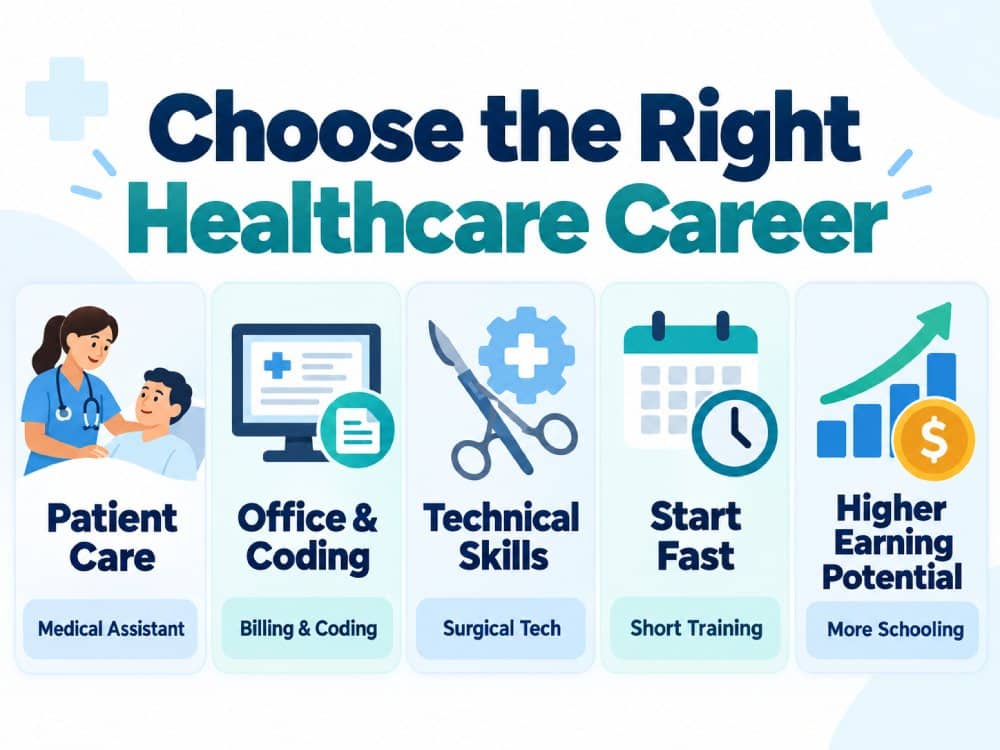
Instead of selecting a career based on the highest salary in a list, start with how you want to work.
If You Enjoy Working Directly With Patients
Consider medical assisting, dental assisting, phlebotomy, or certain nursing and rehabilitation roles. These occupations involve different levels of responsibility, training, and contact with patients. Medical assisting may be particularly attractive if you want to develop both clinical support and administrative skills.
If You Prefer Computers and Detailed Information
Consider medical billing, coding, or medical records work. These careers reward accuracy, organization, confidentiality, and familiarity with healthcare information systems. They may suit someone who wants to contribute to healthcare without performing frequent hands-on clinical procedures.
If You Prefer Technical or Procedure-Based Work
Explore surgical technology, radiologic technology, or diagnostic medical sonography. These roles can require more specialized training but may offer higher national median earnings.
If You Want to Start Training Soon
Look closely at the specific curriculum and length of certificate or diploma programs. Ask how much time is spent in practical instruction, which credentials are awarded, and what additional qualifications employers might require.
If You Want the Highest Potential Earnings
Compare the total educational pathway, not just the salary. A program lasting two or three years may lead toward a higher-median-paying occupation, but it can also involve additional tuition, licensing, prerequisites, and time outside the workforce.
Start Exploring Healthcare Career Training in California
Choosing a healthcare career is not only about finding the highest salary. It is about identifying a realistic route from where you are today to the kind of work you want to do. American College of Healthcare and Technology offers career-focused training across several healthcare fields, with campus locations in Riverside, Santa Ana, and Huntington Park.
If you are comparing your options, reviewing the programs can help you learn about course content, published training lengths, campus availability, and the next steps toward enrollment.
Ready to start your healthcare career?
Get program details, admission requirements, and personalized guidance from our team.
Request Program Information →Explore ACHT’s programs and request information about available training options, schedules, tuition, and financial aid for those who qualify.